In the rapidly evolving world of IoT, smart home devices, wearables, and connected gadgets demand microcontrollers that offer not only processing power but also flexible, ultra-low-power wireless connectivity. The STM32WBA64/65 series from STMicroelectronics emerges as a leading solution — combining a modern 32-bit core, multiprotocol radio, robust security, and flexible integration for a broad spectrum of applications.
Why STM32WBA64/65?
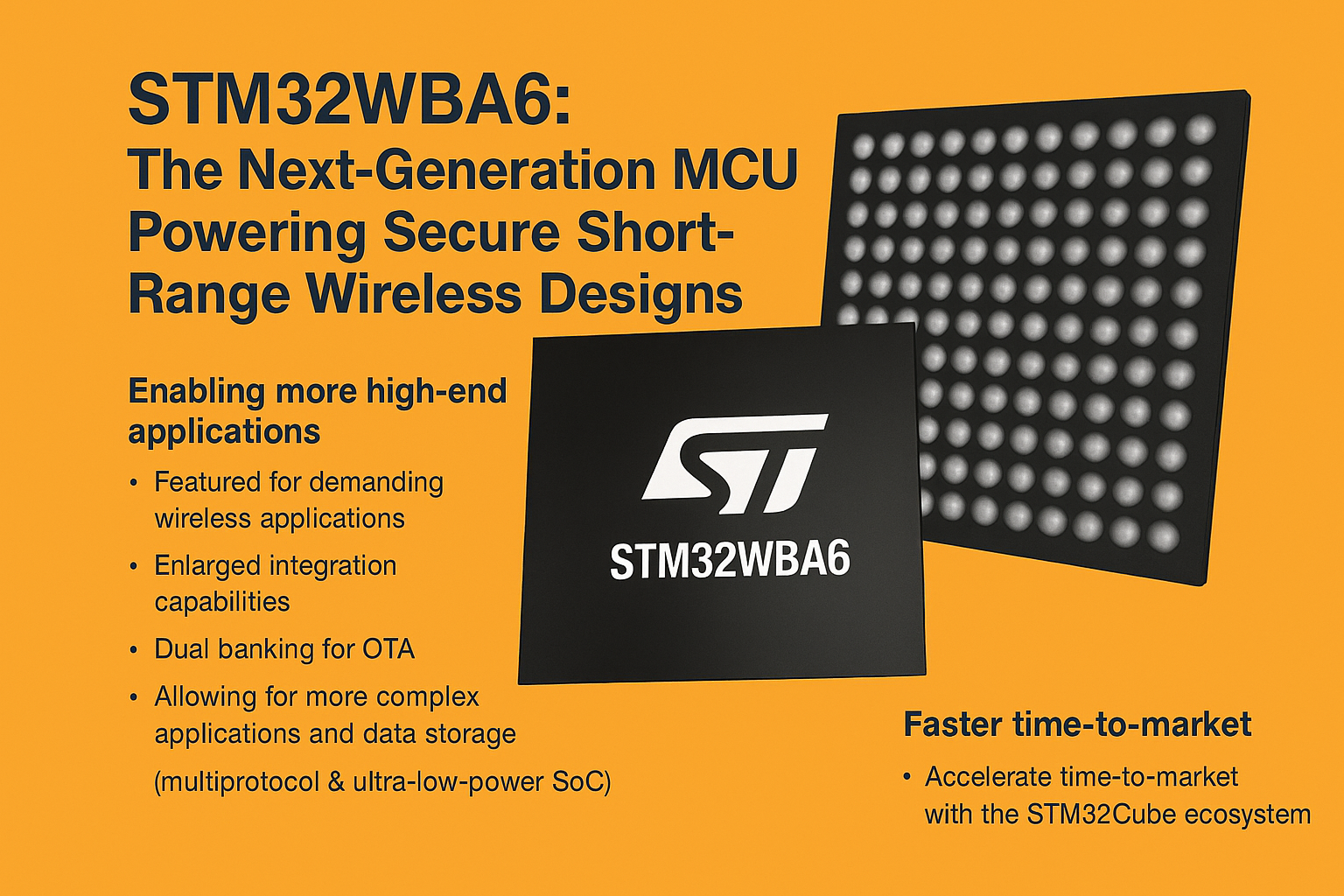
At its core, the STM32WBA64/65 family packs a powerful 32-bit Arm® Cortex®-M33 CPU (up to 100 MHz), paired with up to 2 MB of Flash memory and 512 KB of SRAM — enough headroom for complex firmware, over-the-air updates, and feature-rich applications.
What truly sets WBA64/65 apart is its built-in 2.4 GHz multiprotocol radio, supporting not just one, but several of the most relevant wireless standards for IoT and smart devices:
-
Bluetooth® Low Energy (BLE) — including the latest BLE 5.x features like LE 2M, LE Coded, extended advertising, direction finding, LE Audio, and more.
-
IEEE 802.15.4 — enabling protocols like Zigbee®, Thread, and even the emerging IoT standard Matter for robust mesh connectivity.
-
Flexibility for proprietary protocols if your application requires custom wireless handling.
This multiprotocol support — on a single chip — gives developers ample flexibility. Whether you need BLE for direct pairing to smartphones, Zigbee/Thread/Matter for mesh networks, or custom wireless layers, WBA64/65 can handle it all.
Key Features — What Makes It Stand Out
Here’s a breakdown of what the STM32WBA64/65 offers under the hood, and why it matters:
-
High Output Power & Connectivity Range
The embedded radio delivers up to +10 dBm output power, with sensitivity around –96 dBm for BLE at 1 Mbps and –100 dBm for IEEE 802.15.4 at 250 kbps. This extends communication range, which is crucial for smart-home installations, device-to-device communication, or remote sensors. -
Low-Power Design for Battery Efficiency
The MCU supports aggressive power-saving modes: standby and stop modes with ultra-low current draws (µA to nA range depending on configuration) and autonomous peripherals handled via DMA even during low-power states. -
Flexible Memory & Packaging Options
Designers can choose among multiple packaging formats — from 48-pin and 68-pin UFQFPN, to compact WLCSP, or larger BGA — enabling optimized board layouts depending on the application.
Plus, with up to 2 MB Flash and 512 KB RAM, it’s suited for feature-rich applications, firmware with OTA updates, and even audio streaming or mesh node stacks. -
Rich Peripheral & Interface Support
Beyond wireless connectivity, WBA64/65 supports abundant digital/analog peripherals — GPIOs, multiple SPI, I²C, UARTs, USB (in some variants), ADCs, timers, DMA, touch sensing, and more — making it a versatile MCU for complex embedded systems. -
Robust Security
With built-in Arm TrustZone® technology, cryptographic accelerators, and compliance with security evaluation standards (SESIP Level 3), the series addresses security and privacy requirements — essential for connected, consumer-facing devices. -
Ecosystem & Software Support
The WBA family is fully integrated into the existing STM32 ecosystem — with support in STM32CubeMX, STM32CubeIDE, HAL libraries, example code, and even ready development boards like NUCLEO-WBA65RI or the WBA65I-DK1 Discovery kit. This reduces development overhead and accelerates time-to-market.
Real-World Use Cases
Given this feature set, STM32WBA64/65 MCUs find their sweet spot in a wide spectrum of modern wireless and IoT applications:
-
Smart Home & Building Automation — Devices like smart locks, lighting controllers, environmental sensors, or home automation hubs — where BLE pairing or Zigbee/Matter mesh may coexist. The multiprotocol capability makes WBA64/65 ideal.
-
Wearables & Personal Devices — Fitness bands, health trackers, or wearable sensors benefit from the ultra-low-power radio, BLE audio, and modest memory footprint. The low standby current ensures longer battery life — a key for wearables.
-
Industrial & Smart Metering — Battery-powered sensors, asset trackers, and wireless metering devices in industrial or utility environments require robust connectivity, extended range, and secure data communications — which WBA64/65 delivers.
-
Audio & Multimedia Devices — BLE Audio, mesh networking, and adequate memory/peripherals allow use in wireless headsets, smart speakers, or audio modules in IoT devices.
-
Prototyping & Development — Thanks to boards like the NUCLEO-WBA65RI or Discovery kits (e.g., WBA65I-DK1), developers can quickly prototype and validate applications before moving to custom PCBs.
Advantages Over Traditional MCUs + Radios
Traditionally, many IoT devices used a separate microcontroller and radio (BLE or 802.15.4) — increasing BOM complexity, PCB area, and integration challenges. The STM32WBA series simplifies this drastically:
-
Single-chip multiprotocol solution lowers BOM, simplifies RF layout, and reduces board space.
-
Tight integration with STM32 software ecosystem — no reinvention: developers familiar with STM32 tools can leverage existing knowledge.
-
Scalable design path — starting from simpler variants (less flash/RAM, fewer interfaces) and scaling to more capable ones (WBA65) for advanced applications. This allows design reuse and future-proofing.
Things to Keep in Mind (Design Considerations)
While WBA64/65 brings many advantages, designers should consider:
-
RF layout requirements — as with any 2.4 GHz radio, proper PCB layout, antenna design, and grounding are crucial for reliable wireless communication.
-
Power budgeting — although the MCU is optimized for low power, total system consumption depends on peripherals (sensors, displays, external radio activity), so plan accordingly for battery-powered devices.
-
Regulatory compliance — though WBA64/65 supports global standards and regulations (e.g., RED, FCC), any external components (e.g. antennas, power amplifiers) must also comply with local/regional regulations.
Conclusion
The STM32WBA64/65 series represents a strategic leap forward for wireless-enabled embedded systems — marrying the strength and familiarity of STM32 MCUs with versatile, multiprotocol 2.4 GHz radio connectivity, robust security, and energy-efficient design. For anyone building modern IoT devices — be it smart home gadgets, wearables, industrial sensors, or audio peripherals — WBA64/65 offers a highly integrated, future-proof platform that simplifies design, accelerates development, and reduces BOM complexity.
Given its memory capacity, rich peripherals, and wireless flexibility, WBA64/65 is especially attractive for projects that demand more than “just a simple BLE MCU.” Whether you’re prototyping on a Nucleo or building a bespoke PCB, this series gives you room to grow — from basic BLE sensor nodes to complex, multiprotocol, connected devices ready for the global market.
Author Profile

- 20+ years embedded hardware design professional with a burning passion for teaching. Sharing the intricate world of embedded hardware is my mission and joy.
Latest entries
 Tech Updates30 November 2025STM32WBA6: The Next-Generation MCU Powering Secure Short-Range Wireless Designs
 Blogs24 November 2025High-Speed PCB Layout Design Guide-104
 Tech Updates14 September 2025Renesas Launches RL78/L23 Ultra-Low-Power MCUs to Power Smarter Home Appliances
 Blogs7 September 2025High-Speed PCB Layout Design Guide-103